 Masters
Top 5 Mistakes When Buying a Mattress
In this guide
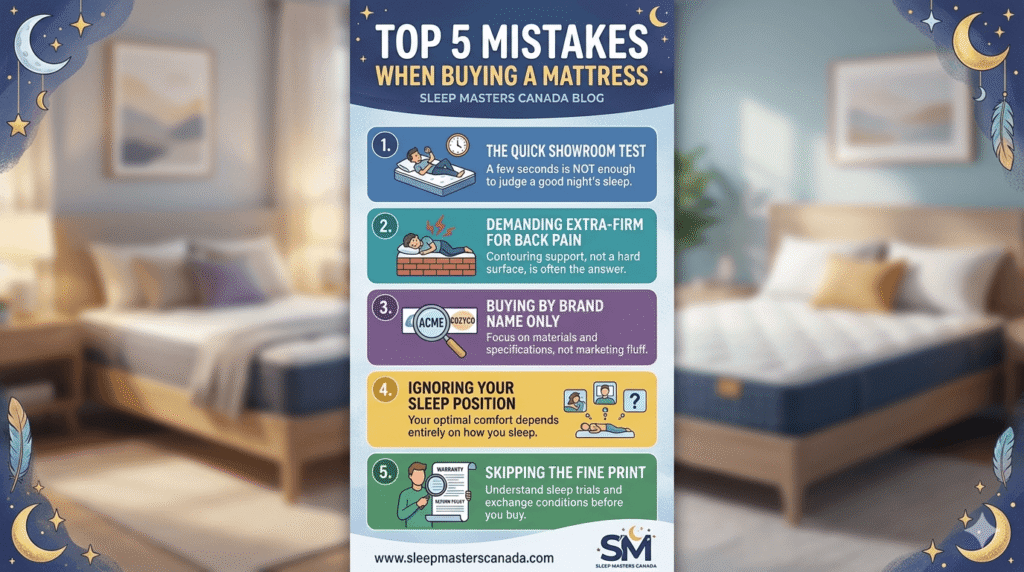
The five mistakes we see most often in our Toronto showroom: deciding after a 30-second lie-down, assuming extra-firm cures back pain, shopping by brand name instead of foam density and coil count, ignoring your own sleeping position and body weight, and skipping the fine print on trials and warranties. Each one is easy to avoid once you know what to look for, and avoiding them is the difference between a bed you love for ten years and one you regret by spring.
Key takeaways
- Test a mattress for 10 to 15 minutes in your real sleeping position, with your own pillow if you can.
- Medium-firm, not rock-hard, is the clinically supported choice for most back pain.
- Compare coil type, foam density, zoning and profile, not model names that change from store to store.
- Side, back, stomach and plus-size sleepers each need a different build.
- Ask about break-in periods, exchange fees and foundation requirements before you pay.
A new mattress is one of the best investments you can make in your health, yet most Canadians buy one blind. The wrong choice does not just cost money; it means morning back pain, poor alignment and years of broken sleep. Here are the five mistakes to avoid and exactly how to avoid them.
1. Relying on the 30-Second Showroom Test
The mistake
Lying down for half a minute, staring at the ceiling, and declaring the bed perfect. A brief, self-conscious test cannot tell you how your body will feel after eight hours.
Why it ruins your sleep
It takes your muscles and spine 10 to 15 minutes of continuous rest to fully relax. A quick sit or a press of the hand tells you what the top comfort layer feels like, not how the support core will hold you overnight.
How to fix it
- Test realistically: 10 to 15 minutes in the position you actually sleep in.
- Bring your pillow: the wrong pillow distorts your spinal alignment and your judgement.
- Shop with your partner: test motion isolation and edge support together, and have one person roll over while the other lies still.
2. Choosing an Extra-Firm Mattress for Back Pain
The mistake
Demanding the firmest bed in the store because decades-old advice said hard beds fix bad backs.
Why it ruins your sleep
A mattress that is too firm does not follow the curve of your lower back, so a gap opens under your waist and your muscles work all night to bridge it. It also creates pressure points at the hips and shoulders, which means tossing, turning and morning stiffness.
What the research says: clinical studies consistently find that medium-firm mattresses give the best balance of pressure relief and spinal alignment for the majority of people with back pain. Extra-firm suits heavier back and stomach sleepers; for everyone else it tends to make things worse.
How to fix it
Choose deep structural support with a contouring comfort layer: a medium-firm hybrid or high-density memory foam over pocket coils. Our guide to the best mattress for back pain names specific models.
3. Comparing Brand Names Instead of Material Specifications
The mistake
Assuming a famous name or a big markdown sticker guarantees durability.
Why it ruins your sleep
The industry is notorious for proprietary naming. The same mattress interior can carry three different model names at three stores to stop you price-matching. Buy on the label alone and you may overpay for low-density foams that sag within two or three years.
How to fix it
Ask for the raw specifications and compare these four:
| Specification | What to look for | Why it matters |
|---|---|---|
| Coil type | Individually wrapped pocket coils | Localized support and far better motion isolation |
| Foam density | 1.8 lb/ft³+ for poly foam, 3 to 4 lb/ft³+ for memory foam | Decides how many years before the bed sags |
| Zoned support | Reinforced centre third | Keeps the hips from sinking and the spine aligned |
| Profile | Total height and layer-by-layer breakdown | So you are not paying premium prices for a thin bed |
4. Disregarding Your Sleeping Position and Body Weight
The mistake
Buying the bed a friend loves, or the highest-rated model online. Every body is a different combination of weight, shape and sleeping habit.
Why it ruins your sleep
A mattress that feels like a cloud to a 130-lb side sleeper will give a 220-lb stomach sleeper severe lower back pain. Position decides where you need pressure relief and where you need push-back.
How to fix it
- Side sleepers: softer to medium, with plush memory foam or latex to cushion shoulders and hips. See best mattress for side sleepers.
- Back sleepers: a true medium-firm that fills the lumbar gap.
- Stomach sleepers: firmer, ideally a heavy-duty hybrid, so the hips do not sink and arch the lower back.
- Plus-size sleepers: high coil counts and high-density transition foams to prevent bottoming out. See best mattress for heavy people.
5. Skipping the Fine Print on Sleep Trials and Warranties
The mistake
Assuming a “10-year warranty” covers everything, or that you can return a mattress for a full refund because you do not like it after a month.
Why it ruins your sleep
Most warranties cover only structural defects, such as a coil breaking through or a body impression deeper than 1.5 inches, not gradual softening or a change in your preference. Some retailers bury return shipping, restocking fees and mandatory exchange clauses in the fine print.
How to fix it
Ask three questions before you pay:
- Is there a break-in period before I can request a comfort exchange? Many stores require 30 nights.
- Are there shipping, pickup or restocking fees if I swap or return the mattress?
- Does my bed frame meet the warranty requirements? An old, sagging box spring can void a new warranty instantly.
Our own terms are published in plain language on the exchanges and returns page, and every mattress comes with a 100-night sleep trial.
Tell us your position, body type and budget. Our non-commissioned team will shortlist three mattresses that fit, not the three with the biggest margin.
Frequently asked questions
How do I know if my mattress is causing my back pain?
If you wake with lower back pain or stiffness that fades within an hour of moving around, the mattress is failing to support your spine overnight. Pain that lasts all day points to something else; see a doctor.
What is the best mattress type for couples?
A pocket-coil hybrid or a memory foam mattress. Both isolate motion well, so you do not feel your partner turning over. A hybrid adds edge support and airflow, which most couples prefer.
How often should you replace a mattress?
Every 7 to 10 years as a rule, sooner if it sags, you wake unrefreshed, or you sleep better in hotels. Flippable and latex mattresses last longer. See how often you should replace your mattress.
Is it better to buy a mattress online or in a store?
In a store, if the store lets you test properly and sells by specification. Online works if you already know the exact build you need and the trial terms are clear. Read buying online vs. in store in Canada for the full comparison.