 Masters
The Ultimate Guide to Buying a Mattress in Toronto: What to Look For and How to Avoid the Over-Markup

In this guide
- Quick Summary: How to Avoid the Mattress Retail Markup
- In-Store Showroom vs. Bed-in-a-Box: Which Is Better for Torontonians?
- The 3 Most Important Mattress Specifications
- Understanding Toronto’s Best Mattress Brands
- How Much Should a Good Mattress Cost in Toronto?
- Why Sleep Masters Canada Does It Differently
- Frequently asked questions
Buying a mattress in Toronto comes down to three things: judge the bed by its specifications (coil count, foam density, one-sided or two-sided), not by the discount sticker; avoid the commissioned big-box showrooms where markups and “70% off” sales are built into the price; and try the mattress in person before you commit. This guide covers what to look for, what a good mattress should cost in the GTA, and how showroom beds compare with bed-in-a-box imports.
Key takeaways
- A permanent sale is not a sale. Compare build specs, not discount percentages.
- Three specs matter most: 800 to 1,000+ pocket coils in a queen, foam density of 1.8 to 2.0 lb/ft³, and whether the bed is flippable.
- Showroom beds last 8 to 15 years; compressed bed-in-a-box foam beds typically 3 to 6.
- In Toronto, the value sweet spot for a quality Canadian-made queen is roughly $800 to $1,500.
- Non-commissioned staff, free GTA delivery and a 100-night trial remove most of the risk.
If you are shopping for a mattress in Toronto or the GTA, you already know how overwhelming it is: a flood of bed-in-a-box Instagram ads on one side, high-pressure corporate showrooms on the other. The industry is also notorious for markups. Department-store mattresses are routinely priced 200 to 300 percent above cost, then “marked down” for a mega-sale that is simply the real price. This guide cuts through it.
Quick Summary: How to Avoid the Mattress Retail Markup
- Skip commissioned salespeople. Traditional chains pay heavy commissions, and those are baked into the sticker. Look for non-commissioned sleep specialists.
- Buy Canadian-made where you can. Imported beds carry shipping, duties and exchange-rate costs. A locally built mattress skips all three. See why Canadian-made matters in Toronto.
- Look past the “70% off” banners. A permanent sale is a pricing trick. Compare coil count and foam density instead.
In-Store Showroom vs. Bed-in-a-Box: Which Is Better for Torontonians?
| Feature | Online bed-in-a-box | Premium showroom mattress |
|---|---|---|
| Material quality | Mostly low-to-mid density poly foams | High-density foams, pocket coils, natural latex |
| Lifespan | 3 to 6 years; prone to early sagging | 8 to 15+ years, especially flippable models |
| Try before you buy | Blind purchase; relies on returns | Test support and feel in person |
| Edge support | Weak; compressed edges lack reinforcement | Reinforced foam encasement or edge coils |
| Delivery | Courier box to the door | Flat, set up in the bedroom, old mattress taken away on request |
Online beds are convenient, but they rarely deliver the deep structural support that back-pain sufferers and heavier sleepers need. Lying on a mattress in person remains the most reliable way to check spinal alignment. We go deeper in buying a mattress online vs. in store in Canada.
The 3 Most Important Mattress Specifications
Ignore the trademarked foam names and focus on three structural metrics. A transparent store will always share them.
A. Pocket coil count and zoning
Support comes from the core. Individually wrapped pocket coils contour to your body and isolate motion far better than old interconnected coils. Target: 800 to 1,000+ coils in a queen. Premium Canadian models add reinforced coils through the centre third to stop the hips sinking.
B. Foam density: the anti-sagging metric
The number-one reason mattresses fail is comfort foam that softens and dips. Durability is measured by weight per cubic foot, not thickness. Target: 1.8 to 2.0 lb/ft³ for poly foams, 4 lb/ft³ or more for memory foam. Cheaper online beds often use 1.5 lb foam or less, which breaks down quickly under body heat and weight.
C. Two-sided (flippable) architecture
Most modern mattresses are one-sided and can only be rotated. A flippable mattress spreads wear across both faces and can double the life of the bed. Dreamstar’s Double Life and Serenity II series are among the few still built this way. See where to buy a flippable mattress in Toronto.
Understanding Toronto’s Best Mattress Brands
- Dreamstar Bedding: built in the GTA, luxury-tier construction without the luxury retail price, and one of the few makers still producing high-density, two-sided flippable pocket-coil mattresses.
- Stearns & Foster: the heritage luxury brand, hand-layered materials and heavy-duty support for shoppers who want the best.
- Beautyrest: the inventor of pocket-coil technology; the Centennial and World Class lines pair motion separation with cooling covers that suit humid Toronto summers.
- Serta and Sealy: dependable mid-range hybrids and the Posturepedic support system, strong choices for back and stomach sleepers.
How Much Should a Good Mattress Cost in Toronto?
For a high-quality, Canadian-made queen with pocket coils and high-density foam, the value sweet spot is roughly $800 to $1,500. Below about $600, foam density and coil quality are usually compromised. Above $2,500 in a conventional retail setting you are often paying brand markup and commission rather than better materials; the exception is genuine luxury builds such as Stearns & Foster. Our mattresses under $700 page shows what honest entry-level pricing looks like.
Every mattress on our site lists its firmness, construction and live price. Tell us how you sleep and we will shortlist three.
Why Sleep Masters Canada Does It Differently
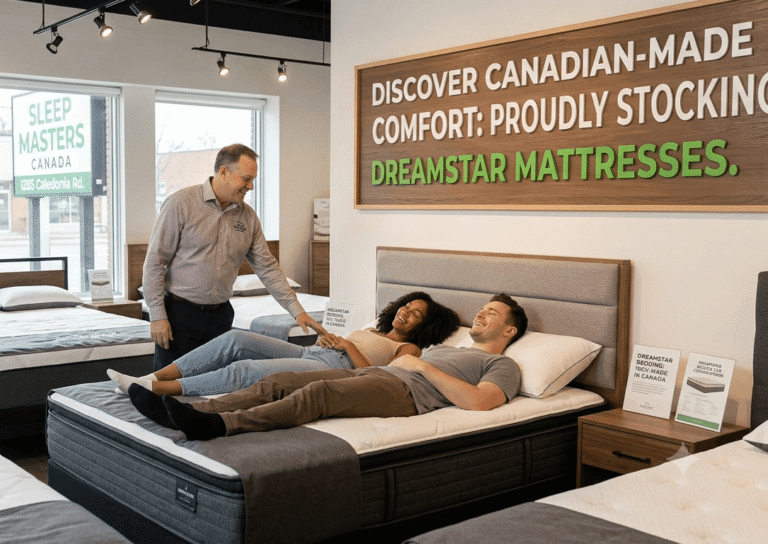
We do not believe you should pay inflated retail prices for a good night’s sleep. Our North York showroom runs on a transparent model: zero commissions and zero pressure, so the only goal is the right mattress for your body; direct relationships with Dreamstar, Serta, Beautyrest, Sealy and Stearns & Foster that keep prices honest; free delivery across Toronto and the GTA; and a 100-night sleep trial. If the mattress is not right, we make it right.
Visit: 1285 Caledonia Road, North York, ON M6A 1Z4 · Call: (416) 781-7441 · Browse the full collection.
Frequently asked questions
How much should a good mattress cost in Toronto?
Roughly $800 to $1,500 for a quality Canadian-made queen with pocket coils and high-density foam. Below $600 usually means thinner foams and fewer coils; above $2,500 is often markup unless it is a true luxury build.
What is the best mattress for back pain?
A medium-firm to firm mattress with zoned pocket coils that keeps the hips level with the shoulders. Models such as the Dreamstar Orthopedic Supreme and Chiro Firm are built for this. See our back pain guide.
How do I get a mattress into a Toronto condo?
Choose a retailer that delivers flat with a two-person crew and books the elevator with your concierge. We measure stairwells and elevators on request and bring the right size the first time.
Are mattress sales in Toronto real?
Some are, many are not. If a store’s “sale” never ends, the sale price is the real price. Compare the specifications and the final price against other stores, not the percentage off.