 Masters
The Side-Sleeper Shoulder Pinch: Why Your Mattress Is Numbing Your Arms (And How to Fix It)

In this guide
- The Anatomy of the Shoulder Pinch: Nerves vs. Blood Flow
- Too Firm vs. Too Soft: How Each Extreme Ruins Your Sleep
- How to Fix the Shoulder Pinch: The 3-Step Formula
- The Best Mattress Types for Side Sleepers in Canada
- Other Reasons Your Arm Falls Asleep at Night
- Visit Sleep Masters Canada
- Frequently asked questions
If you sleep on your side and keep waking up to shake out a numb arm, your mattress is compressing the nerves in your shoulder. A bed that is too firm jams the joint upward; a bed that is too soft lets your torso sink and collapses the shoulder inward. Either way the brachial plexus nerves get pinched and the arm “falls asleep”. The fix is a mattress that lets the shoulder sink while holding the hips and spine level: a zoned hybrid or an organic latex bed, paired with a pillow tall enough to fill the gap to your ear.
Key takeaways
- The numb, heavy arm is mainly nerve compression at the shoulder, with reduced blood flow playing a smaller part.
- Too firm = “park bench”: the shoulder cannot sink. Too soft = “hammock”: the torso sinks and twists the shoulder.
- Look for zoned pocket coils (softer under the shoulders, firmer under the hips) and high-density comfort foam or latex.
- Match pillow height to shoulder width; the mattress cannot fix a flat pillow.
Waking up with pins and needles in your fingers is more than an annoying start to the day. It is a clear sign that your bed is fighting your body. Below we explain the anatomy, the two mattress extremes that cause it, and a three-step formula to fix it.
The Anatomy of the Shoulder Pinch: Nerves vs. Blood Flow
Most people assume a sleeping arm is simply a lack of circulation. Restricted blood flow through the small vessels does play a part, but the dead, heavy feeling is primarily nerve compression. Lying fully on your side concentrates your entire upper-body weight onto one small area: the shoulder joint. Running through that joint is the brachial plexus, the bundle of nerves that serves the arm and hand. When an unyielding surface pushes back against the shoulder, those nerves are squeezed, the brain temporarily loses the signal, and you get paresthesia, the clinical name for pins and needles.
Too Firm vs. Too Soft: How Each Extreme Ruins Your Sleep
| Mattress problem | What happens to your body | Night-time result |
|---|---|---|
| Too firm (the park-bench effect) | The surface does not contour; the shoulder is jammed up toward the neck | Localized pressure, nerve pinch, numb arm, tossing and turning |
| Too soft (the hammock effect) | Heavy hips and torso sink too deep and the body collapses inward over the shoulder | Spinal misalignment, lower back pain, twisted shoulder capsule |
The too-firm mattress
One of the most persistent myths is that a rock-hard bed cures aches. For a side sleeper a rigid surface acts like a wall. The shoulder cannot compress into the bed, so it is pushed up toward the ear, the neck goes out of line and the joint takes enormous pressure. We cover the myth in why your back hurts in the morning.
The too-soft mattress
An ultra-plush, low-density foam bed feels wonderful for thirty seconds. Without structural support, your heavier midsection sags into the comfort layers, the upper spine twists and the bottom shoulder folds inward under the uneven load. You wake with a numb arm and a sore lower back.
How to Fix the Shoulder Pinch: The 3-Step Formula
1. Choose zoned pocket coils (foundation support)
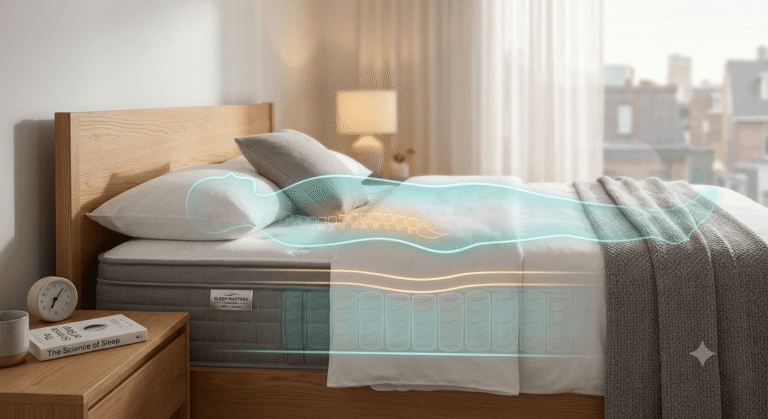
Look for an individually wrapped pocket-coil core with zoning: thinner, more flexible coils under the shoulders so they can sink, and thicker, heavier-gauge coils under the hips and lumbar spine so the torso stays level.
2. Invest in high-density comfort layers (pressure relief)
Cheap, low-density poly-foam bottoms out under a shoulder. Choose premium cooling gel memory foam or natural organic latex. Both contour around the curve of the shoulder blade and spread weight across the surface, which is what removes the pressure point.
3. Match your pillow height to your shoulder width (realignment)
The mattress can only do so much if the pillow is wrong. Side sleepers need a thicker, supportive pillow that fills the gap between the ear and the mattress so the head does not tilt down. A pillow that is too flat adds a second pinch at the neck. Our pillow collection includes contour and gel options sized for side sleepers.
The Best Mattress Types for Side Sleepers in Canada
Premium hybrid mattresses
A hybrid combines the contouring of foam with the deep support of steel coils. Models such as the Dreamstar Ariya Hybrid and the Organic Meadow Hybrid Plush absorb shoulder depth in their comfort layers while the pocket-coil core keeps the lower back from sagging.
Organic latex mattresses
Natural latex is highly resilient and gives an instant-response pressure relief that memory foam cannot match: it yields completely at the shoulder and hip while pushing back gently under the waist. It is also extremely durable, so it does not develop the dips that cause shoulder pinching over time. Browse our organic mattresses.
Other Reasons Your Arm Falls Asleep at Night
- Sleeping on a bent arm or with the arm under the pillow compresses the nerves at the elbow and wrist. Keep the bottom arm forward, not tucked underneath.
- A pillow between the knees stops the top leg pulling the pelvis and spine forward, which can twist the shoulder.
- Persistent numbness during the day, weakness, or numbness on both sides is not a mattress problem; see a doctor to rule out nerve or circulation conditions.
Tell us your weight range and pillow preference and we will suggest three mattresses that let the shoulder sink without losing support.
Visit Sleep Masters Canada
You do not have to live with fragmented sleep and morning arm numbness. If you are in the GTA, visit our North York showroom at 1285 Caledonia Rd. Our non-commissioned team will look at your sleeping position, map your pressure points and match you to a mattress that fits your body and your budget, with free delivery across Toronto and the GTA and a 100-night sleep trial. For a full ranking of models, read our best mattress for side sleepers in Canada.
Frequently asked questions
Why does my arm fall asleep when I sleep on my side?
Your upper-body weight presses the shoulder into the mattress and compresses the brachial plexus nerves, which cuts the signal to the arm. A mattress that is too firm or too soft makes it worse by jamming or twisting the shoulder.
Is a soft mattress better for side sleepers with shoulder pain?
Softer at the surface, yes, but not soft throughout. You want a cushioning comfort layer over a supportive, ideally zoned, coil core. An all-over soft bed lets the hips sink and twists the shoulder.
Can a mattress topper fix shoulder numbness?
A 2 to 3 inch memory foam or latex topper can help if your mattress is too firm but otherwise supportive. If the bed is sagging or too soft, a topper will not help.
What pillow is best for side sleepers?
A firmer, higher-loft pillow, roughly the width of your shoulder, that keeps your head level with your spine. Contour memory foam, latex and adjustable fill pillows all work well.
 Back & Pain ReliefWhy Your Back Hurts in the Morning: The Ultimate Canadian Mattress Guide for Pain ReliefOct 8, 2026 · 7 min read
 Back & Pain ReliefBest Mattress for Back Pain (2026 Guide)Oct 8, 2026 · 6 min read
 Back & Pain ReliefThe Best Mattress for People with Scoliosis: A Complete GuideOct 8, 2026 · 5 min read