 Masters
Why Your Back Hurts in the Morning: The Ultimate Canadian Mattress Guide for Pain Relief
In this guide
- Why Does My Lower Back Hurt When I Wake Up?
- The Myth of the Extra-Firm Mattress
- How to Match Your Sleeping Position to the Right Firmness
- The 3 Best Mattress Builds for Pain Relief
- Four Things to Fix Before You Buy a New Mattress
- When to See a Doctor
- Sleep Pain-Free with Expert Guidance
- Frequently asked questions
If your lower back hurts for the first half hour after you get up and then loosens as you move, your mattress is almost certainly the cause. Morning back pain comes from poor spinal alignment overnight: a bed that is too soft lets your hips sink into a hammock, a bed that is too firm leaves a gap under your lumbar curve. For most people the fix is a medium-firm hybrid with pocket coils and a contouring latex or foam comfort layer. Here is how to tell which problem you have and what to buy instead.
Key takeaways
- Pain that fades within 30 to 60 minutes of waking points to the mattress; pain that lasts all day points to something medical.
- The old “sleep on an extra-firm bed” advice is a myth. Medium-firm is the sweet spot for most backs.
- Match firmness to position: side sleepers medium-soft to medium-firm, back sleepers medium-firm to firm, stomach sleepers firm.
- Pocket coils, hybrids and natural latex are the three builds that keep the spine level all night.
- A topper can soften a too-firm bed but cannot rescue a sagging one.
Rolling out of bed feeling like you ran a marathon in your sleep is one of the most common complaints we hear in our Toronto showroom. People blame their age, their posture or their desk job. Very often the culprit is right underneath them: a sagging, unsupportive or badly matched mattress.
Why Does My Lower Back Hurt When I Wake Up?
When you lie down, your muscles finally get to switch off. If the mattress does not hold your body in line, those muscles work all night to keep your spine straight, and you wake up with the stiffness to prove it.
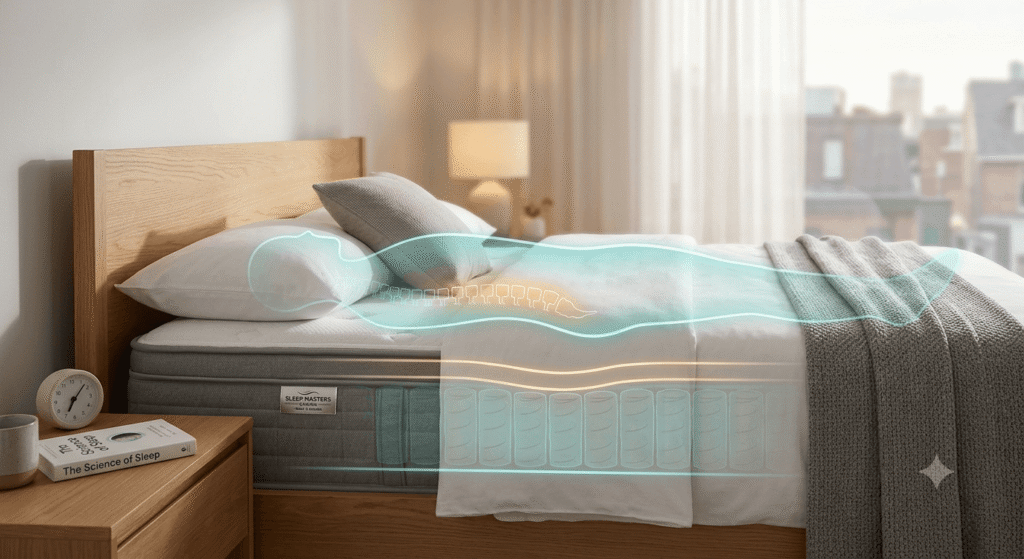
Your spine has a natural S-curve. On a mattress that is too soft, your hips, the heaviest part of your body, sink deepest and the spine bows into a U. On a mattress that is too firm, your shoulders and hips are pushed up, a gap opens under your waist and the lumbar muscles strain to bridge it. Both end the same way: a sore lower back by morning.
Quick self-check: lie on your back on your current mattress and slide a hand under the small of your back. If it slips in easily with lots of room, the bed is too firm. If your hips feel noticeably lower than your chest, it is too soft or has sagged.
The Myth of the Extra-Firm Mattress
For decades the standard advice was: bad back, hard bed. Some people even slid plywood under the mattress. Modern sleep research has thoroughly busted this. An extra-firm mattress behaves like a floor; it does not follow the curve of your waist and lower back, so those areas get no support at all. Extra-firm works for some bodies, usually heavier back sleepers, but it is not a one-size-fits-all cure. For most people, a medium-firm mattress is the clinically supported sweet spot for back pain. Our full guide to the best mattress for back pain ranks specific models.
How to Match Your Sleeping Position to the Right Firmness
| Sleeping position | What your spine needs | Recommended firmness |
|---|---|---|
| Side sleeper | Pressure relief so the shoulders and hips sink just enough to keep the spine straight | Medium-soft to medium-firm (4 to 6 out of 10) |
| Back sleeper | Consistent lumbar support so the pelvis does not tilt downward | Medium-firm to firm (6 to 8) |
| Stomach sleeper | Maximum support under the hips; sinking arches the lower back | Firm to extra-firm (7 to 9) |
| Combination sleeper | A balance that cushions on the side and supports on the back | Medium to medium-firm (5 to 7) |
Body weight shifts these numbers. Over about 230 lb, move one step firmer in any position; under about 130 lb, one step softer. Every mattress on our site carries a firmness rating out of 10 so you can compare across brands.
The 3 Best Mattress Builds for Pain Relief
1. Pocket coil mattresses: best for targeted support
Unlike old innerspring beds where every coil is wired together, pocket coils are individually wrapped and compress independently, so the mattress follows your weight distribution and keeps the spine level. They also stop motion transfer, so a restless partner does not disturb your back all night. Many models add a firmer zone through the centre third for extra lumbar support.
2. Hybrid mattresses: the best of both
A hybrid pairs a pocket-coil base with a thick comfort layer of memory foam, gel foam or latex. The coils give the deep structural support your spine needs; the foam cradles the joints and relieves pressure points. This is the construction we recommend most often for back pain.
3. Natural organic latex: best for durability
If you want a natural option, organic latex is remarkably supportive. Where memory foam has a sinking feel, latex is responsive: it pushes back gently, keeping the spine lifted while still relieving pressure at the hips and shoulders, and it holds its support for a decade or more.
Four Things to Fix Before You Buy a New Mattress
- Your pillow. A pillow that is too high or too flat twists the neck and the strain travels down the spine. Side sleepers need a thicker pillow than back sleepers.
- Your foundation. A sagging box spring or a slatted frame with wide gaps makes even a new mattress feel soft in the middle.
- Your position. Back sleepers: a pillow under the knees flattens the lumbar curve. Side sleepers: a pillow between the knees keeps the hips level. Stomach sleepers: a thin pillow under the pelvis.
- The age of the bed. If it is more than 8 years old and you wake up stiff, the comfort layers have probably collapsed. See how often you should replace your mattress.
Answer a few questions about how you sleep and our non-commissioned team will reply within 24 hours with a personal recommendation.
When to See a Doctor
A mattress fixes mechanical, posture-related stiffness. If your pain is constant through the day, radiates down a leg, comes with numbness or weakness, follows an injury, or wakes you at night, see a physician or physiotherapist first. A new bed will help you recover, but it should not replace a diagnosis.
Sleep Pain-Free with Expert Guidance
At Sleep Masters Canada we do not do high-pressure sales. Our showroom is staffed by non-commissioned sleep specialists whose only job is to match you to a mattress that fits your sleeping position, body type and pain points, and you can lie on every option at 1285 Caledonia Rd in North York before deciding. Every mattress we carry comes with free GTA delivery and a 100-night sleep trial, so if your back does not agree with the choice, we will make it right.
Frequently asked questions
How do I know if my mattress is causing my back pain?
If your back hurts for the first 30 to 60 minutes after waking and the pain fades as you move and stretch, the mattress is the likely cause. If it hurts all day, or the pain radiates or comes with numbness, see a doctor; it may be an underlying condition.
Is a firm mattress better for back pain?
Not for most people. Studies and our showroom experience both point to medium-firm as the best all-round choice. Extra-firm suits heavier back and stomach sleepers; for side sleepers it usually makes things worse.
How often should I replace my mattress to prevent back pain?
Quality mattresses last 8 to 12 years, longer for latex and flippable designs. Foams degrade and coils lose tension gradually, so if your bed is past 8 years and you wake up stiff, it is time.
Can a mattress topper fix my back pain?
A topper can soften a bed that is too firm. It cannot fix a sagging mattress: the topper simply sinks into the dip. If the support core has gone, replace the mattress.
What type of mattress do chiropractors recommend?
Most recommend a medium-firm mattress that keeps the spine neutral, typically a pocket-coil or hybrid build with a supportive core and a moderate comfort layer, rather than a very soft or very hard bed.
 Back & Pain ReliefThe Side-Sleeper Shoulder Pinch: Why Your Mattress Is Numbing Your Arms (And How to Fix It)Oct 8, 2026 · 6 min read
 Back & Pain ReliefBest Mattress for Back Pain (2026 Guide)Oct 8, 2026 · 6 min read
 Back & Pain ReliefThe Best Mattress for People with Scoliosis: A Complete GuideOct 8, 2026 · 5 min read