
 Serta
Serta Simmons BeautyRest®
 Sealy Mattresses
 Dreamstar Mattresses
 Pocket Coil
 Memory Foam
 Pillow-Top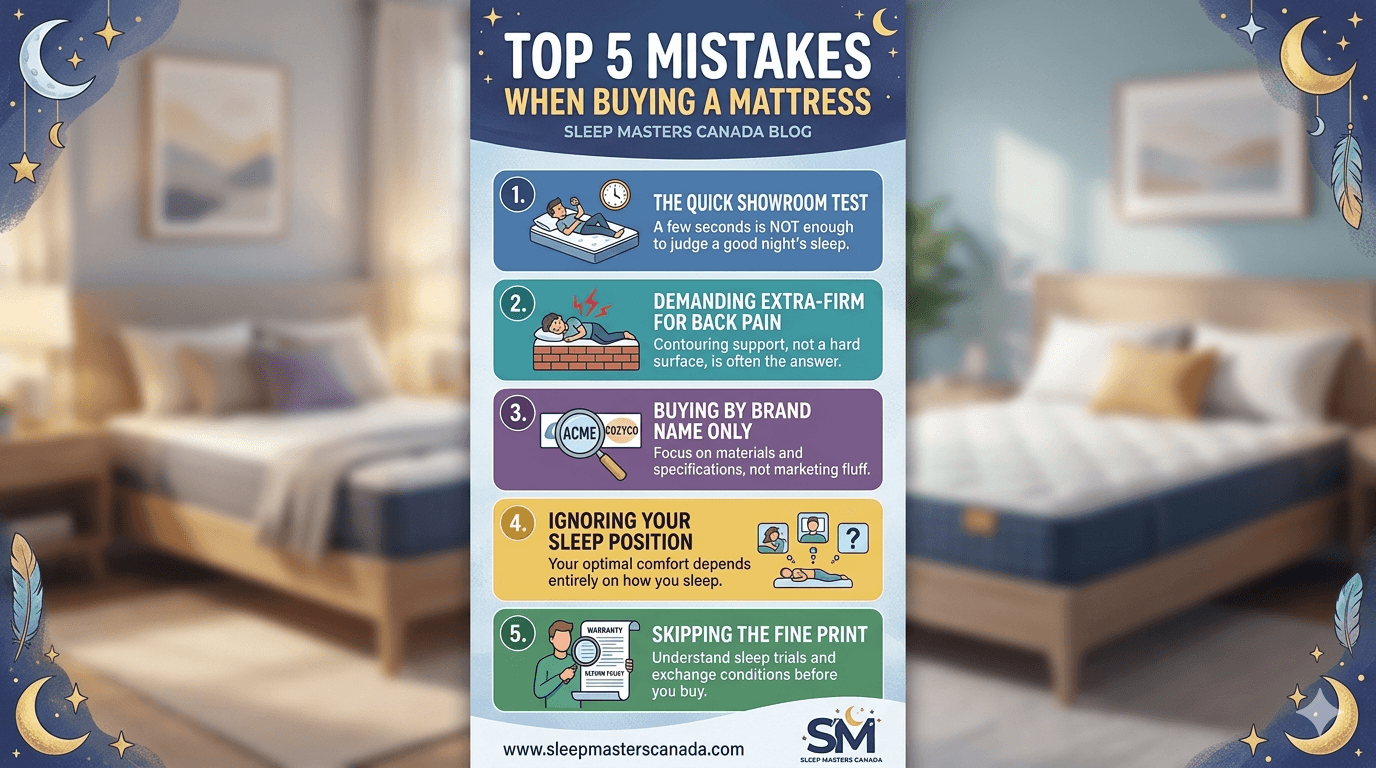
Top 5 Mistakes When Buying a Mattress
Quick Summary: The Biggest Mattress Buying Mistakes
Don’t have time to read the full guide? Here is a quick breakdown of what to avoid when purchasing your next bed:
-
Mistake 1: Buying a mattress based purely on a “30-second showroom test.”
-
Mistake 2: Assuming a rock-hard, extra-firm mattress is best for chronic back pain.
-
Mistake 3: Shopping purely by mattress brand name rather than checking raw material specifications like foam density and coil count.
-
Mistake 4: Ignoring your primary sleeping position and body weight requirements.
-
Mistake 5: Rushing the process without reviewing the sleep trial and warranty details.
Investing in a new mattress is one of the most important decisions you can make for your health, yet many Canadians rush into the purchase blind. A bad mattress choice doesn’t just hurt your wallet, it leads to morning back pain, poor spinal alignment and years of fragmented sleep.
At Sleep Masters Canada, we believe in total transparency. To help you navigate the confusing world of sleep marketing, we have compiled the top 5 mistakes people make when buying a mattress and exactly how you can avoid them.
1. Relying on the “30-Second Showroom Test”
What is the mistake?
Many shoppers walk into a mattress store, lay down on a bed for 30 seconds while staring at the ceiling, and declare it the perfect fit. A brief, self-conscious test in a showroom cannot accurately replicate how your body will feel after eight hours of continuous sleep.
Why it ruins your sleep
Research shows it takes your muscles and spine at least 10 to 15 minutes of continuous resting to completely relax. A quick sit or press of your hand only tells you what the top comfort layer feels like, not how the support system will hold up overnight.
How to fix it
-
Test realistically: Spend at least 10–15 minutes on a mattress in your actual sleeping position (e.g., on your side or stomach).
-
Bring your pillow: Testing a bed with a mismatched pillow can distort your spinal alignment.
-
Shop with your partner: If you share a bed, test it together to evaluate motion isolation and edge support.
2. Choosing an Extra-Firm Mattress for Back Pain
What is the mistake?
One of the most persistent sleep myths is that a rock-hard, extra-firm mattress is the only cure for chronic back pain. Shoppers frequently demand the firmest option available because an outdated piece of advice told them to do so.
Why it ruins your sleep
If a mattress is too firm, it won’t contour to the natural curves of your body. This creates gaps between your lower back and the bed, forcing your muscles to work overtime all night. It also creates painful pressure points on your hips and shoulders, leading to tossing, turning, and morning stiffness.
What the Experts Say: Clinical studies consistently show that medium-firm mattresses provide the optimal balance of pressure relief and spinal alignment for the vast majority of back pain sufferers.
How to fix it
Look for a mattress that offers deep structural support but features a contouring comfort layer (like a medium-firm hybrid mattress or high-density memory foam) to cushion your joints.
3. Comparing Mattress Brand Names Instead of Material Specifications
What is the mistake?
Shoppers often fixate entirely on a famous brand name or a retail markdown sticker. They assume that a higher price tag or a household name automatically equals superior durability.
Why it ruins your sleep
The mattress industry is notorious for “proprietary” naming tricks. The exact same mattress interior can be given three different model names at three different retail stores to prevent you from price-matching. If you buy based on the brand label alone, you might end up overpaying for low-density foams that sag within two to three years.
How to fix it
Ignore the marketing fluff and ask for the raw technical specifications. Use this checklist to compare value:
| Specification Factor | What to Look For | Why It Matters |
| Coil Type | Pocketed / Individually Wrapped Coils | Provides localized support and superior motion isolation. |
| Foam Density | At least 3 to 4 lbs/cu.ft. for memory foam | Determines how many years the mattress will last before sagging. |
| Zoned Support | Reinforced center third | Keeps your hips from sinking and maintains spinal alignment. |
| Mattress Profile | Total height and layer breakdown | Ensures you aren’t paying premium prices for a thin mattress. |
4. Disregarding Your Specific Sleeping Position and Body Weight
What is the mistake?
Buying a mattress because your friend loved it, or simply because it is the highest-rated model online. Every individual has a unique combination of body type, weight, and sleeping habits.
Why it ruins your sleep
A mattress that feels like a cloud to a 130-lb side sleeper will likely cause severe lower back pain for a 220-lb stomach sleeper. Your sleeping position dictates where you need pressure relief and where you need firm structural pushback.
How to fix it
Match your mattress build directly to your sleep style:
-
Side Sleepers: Need a softer to medium mattress with plush memory foam or latex layers to cushion the shoulders and hips.
-
Back Sleepers: Require a true medium-firm mattress that fills the gap in the lumbar spine.
-
Stomach Sleepers: Need a firmer mattress (ideally an innerspring or heavy-duty hybrid) to prevent the hips from sinking and arching the lower back.
-
Plus-Size Sleepers: Should look for robust pocket coil counts and high-density transition foams to prevent premature bottoming out.
5. Failing to Read the Fine Print on Sleep Trials and Warranties
What is the mistake?
Assuming that a “10-year warranty” covers everything, or assuming you can return a mattress for a full cash refund if you simply don’t like it after a month.
Why it ruins your sleep
Many warranties only cover structural defects—like a coil breaking through the side or a body impression deeper than 1.5 inches. They do not cover the mattress getting softer over time or changing comfort preferences. Furthermore, some retailers bury hidden return fees, shipping costs, or mandatory exchange clauses in their fine print.
How to fix it
Before tapping your credit card, ask the retailer these three essential questions:
-
Is there a break-in period required before I can initiate a comfort exchange? (Some companies require you to try it for 30 nights).
-
Are there return shipping fees or restocking fees if I choose to swap the mattress?
-
Does my current bed frame meet the warranty requirements? (Using an old, sagging box spring can instantly void a new mattress warranty).
Frequently Asked Questions (FAQ)
How do I know if my mattress is causing my back pain?
If you wake up with lower back pain or stiffness that gradually fades within an hour of stretching and moving around, your mattress is likely failing to support your spine.
What is the best mattress type for couples?
A pocket coil hybrid mattress or a solid memory foam mattress are the best choices for couples. Both designs excel at motion isolation, meaning you won’t feel your partner tossing and turning during the night.
How often should you replace a mattress?
As a general rule, a mattress should be replaced every 7 to 10 years. However, if you notice visible sagging, wake up feeling unrefreshed, or regularly sleep better at hotels than in your own bed, it is time for an upgrade.
Ready to find a mattress built to last without the hidden gimmicks? Explore our collection of premium Canadian-made beds at Sleep Masters Canada or chat with one of our sleep experts today.